4.1M downloads, under 1% donate, and the paywall that asks for support before it delivers value
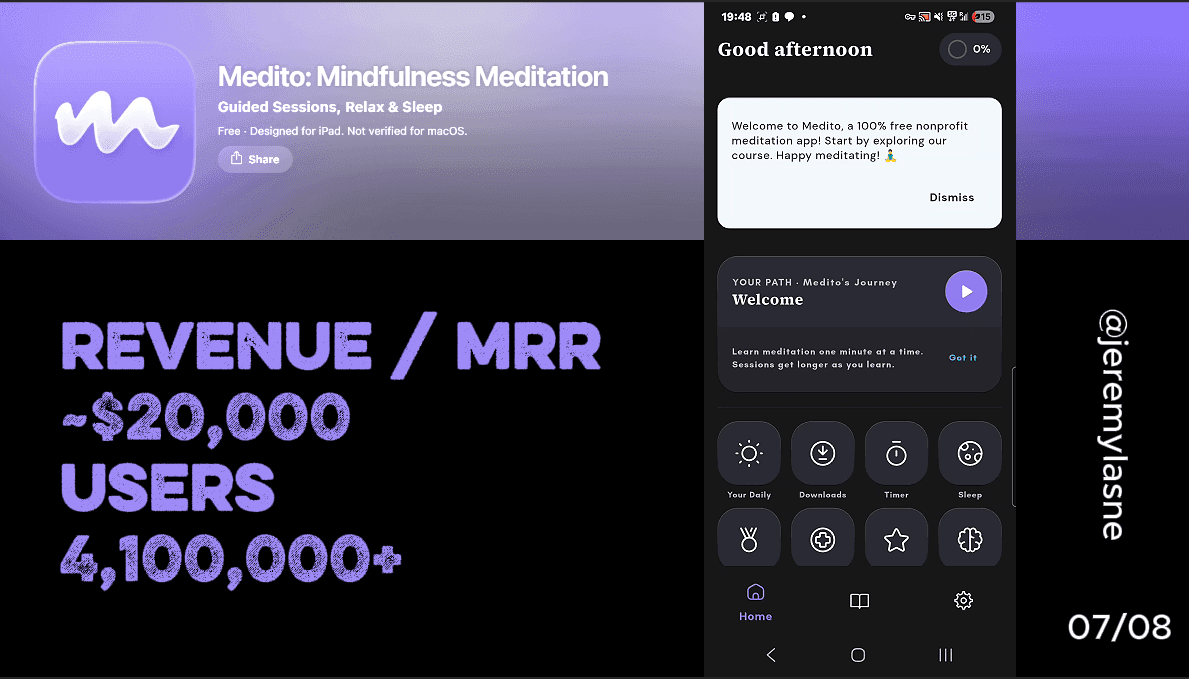
Medito has been downloaded over 4.1 million times across 190+ countries and maintains a 4.9-star rating. Less than 1% of their users have ever donated. Their onboarding runs 7 screens, everything is skippable, there is no paywall, and the donation ask uses a CTA that reads "Support Medito." This is the cautionary teardown in the series -- the one that shows what happens when you optimize for mission over conversion. But it is also the most important teardown for founders building content brands, because Medito's real asset is not the app. It is the ecosystem the app sits inside.
The Numbers
- Total downloads: 4.1M across 190+ countries
- App Store rating: 4.9 stars
- Donor conversion rate: under 1%
- Maximum paying users: ~41,000
- Onboarding screens: 7
- Paywall: none
- Revenue model: voluntary donations, grants, corporate partnerships, retreat income
- Legal structure: registered non-profit in the Netherlands
- Code: fully open source
What Medito Is
Medito is a meditation and mindfulness app created by the Medito Foundation, a nonprofit organization focused on making mental wellness tools accessible to everyone. Unlike most meditation apps, Medito does not use subscriptions, premium tiers, or advertisements. The app is supported entirely by voluntary donations.
Every single meditation, course, sleep story, and feature is free. Not free for 7 days. Not free with limitations. Free. Forever. Medito Foundation is a registered non-profit. They don't have shareholders, growth targets, or a premium tier to upsell users toward.
This is not a product strategy. It is a moral position. And that moral position is the app's primary competitive advantage -- which is also why every onboarding tactic that works everywhere else in this series fails here by design.
The Full Medito Onboarding Breakdown
7 screens: minimum viable onboarding, not a strategy
Medito's onboarding runs 7 screens. A light personalization question or two -- what brings you here, what are you looking for. A few informational screens about what the app contains. The donation ask. Notifications. Into the product.
Nothing is mandatory. You don't need to sign up, enter your email, or create a profile. Download the app and start meditating in under 30 seconds.
That last sentence is the brand promise, stated as a product decision. It is also the explanation for every conversion problem in the onboarding. An app that promises you can start in 30 seconds cannot then run 23 screens of personalization before it lets you meditate. The brevity is not an oversight. It is consistency with the brand.
The problem is that brevity, executed this way, produces an onboarding so thin it fails to build any of the investment that makes the donation ask land. The user who is in the app in 30 seconds is also the user who skips the donation in 3 seconds. There is no relationship yet. There is no commitment. There is no feeling of loss if they leave.
Light personalization: useful but wasted
The two or three personalization questions Medito asks are genuinely relevant. Goal selection, experience level, what's been hard. The answers could inform the first session. They probably do.
But they are so brief, so skippable, and so low-friction that they generate no investment. Compare this to YarnPal's seven yes/no questions, each of which deposits a micro-commitment. Medito's equivalent is one multi-select that the user can tap through in under five seconds.
The personalization is there. It just does not do enough work to justify the donation ask that follows it.
The donation screen: the most unconverted paywall in the series
After the light personalization, Medito asks for a donation. Monthly or yearly. Four price tiers for each: a small amount, a medium amount, a larger amount, and a supporter tier. The CTA: "Support Medito."
This is the lowest-converting paywall construction in this entire series, and the reasons are structural, not executional.
First: the CTA. "Support Medito" is an altruistic ask. It requires the user to care about Medito's mission before they have experienced Medito's product. Most users have been in the app for under 60 seconds at this point. They have not meditated. They have not felt the calm. They do not yet know if this app will help them. Asking them to support it is asking for generosity before value has been delivered.
Every other paywall in this series -- "Try for $0," "Start my free trial," "Try for free" -- frames around the user's benefit. "Support Medito" frames around the organization's need. That framing requires mission alignment the user has not yet had time to develop.
Second: the tiered pricing. Four price options for monthly and four for yearly means eight choices before the user has committed to anything. Choice overload is a conversion killer. The best paywalls in this series offer two options, maximum three. Eight price tiers on a donation ask that the user has no emotional reason to respond to yet is a conversion architecture that was never going to produce high numbers.
Third: everything is skippable. The donation ask can be dismissed instantly. There is no friction, no consequence, no "skip forever" CTA, no reminder that the offer goes away. Skip, and you are in the full product with full access. The cost of skipping is zero and the benefit of skipping is immediate.
Less than 1% of users have ever donated. Given these three structural factors, that number is not surprising. It is the predictable output of an onboarding optimized for frictionlessness and a donation ask optimized for mission alignment rather than conversion.
Notifications: asked after the donation, also skippable
Medito asks for notification permission after the donation screen. This is the correct timing -- after the user has at least seen the value proposition -- but the ask is also skippable. No commitment reframe. No "so mindfulness becomes a habit" framing. Just a standard system prompt.
Given that the user has already skipped the donation and entered the app with full free access, the motivational context for the notification ask is thin. There is nothing the notifications protect. There is no streak at risk, no rank to lose, no bird to disappoint. The notification is just a reminder, with no emotional stakes attached.
The in-app trial prompt: skippable too
After onboarding, Medito surfaces an in-app prompt that functions like a trial suggestion -- try a structured course, commit to a first session, start with the basics. Also skippable.
The in-app trial prompt would be the first-usage moment in any other app in this series. Prayer Lock makes you pray before the paywall. PictureThis makes you scan before the second paywall. YarnPal makes you watch the video before the CTA. Medito makes you... consider it. If you want.
The pattern across the series is clear: first-usage before the commercial ask converts at higher rates than the commercial ask before first-usage. Medito's in-app trial prompt inverts this by being skippable after the donation ask has already been declined. The user who skipped the donation has no emotional reason to engage with a voluntary course suggestion. They are already in full-access mode. The trial prompt offers nothing they do not already have.
What Medito Gets Right That You Cannot Copy Without the Empire
Here is the uncomfortable truth about this teardown: Medito's model is not broken for Medito. It is broken for you, if you try to copy it.
Medito works as a business -- they closed their 2024 funding gap, they are exploring additional wellness services, and they operate a registered non-profit with grants and corporate partnerships -- because the app is one node in a larger ecosystem.
They're exploring additional wellness services and products that could provide sustainable revenue while keeping their core meditation content completely free. They run meditation retreats. They publish research with universities. They have a blog, a social presence, and a community built around a mission that predates the app.
The app, in this context, is a distribution channel for the mission. It acquires users at zero cost because the brand pull of "the only completely free meditation app" is itself a marketing claim that generates press coverage, word of mouth, and organic App Store discovery. The 4.9-star rating from 4.1 million downloads is a credibility asset that attracts corporate partnerships and grants that are not dependent on individual user conversion rates.
This is the brand-as-empire model. The app generates users. The users generate trust. The trust generates partnerships. The partnerships generate revenue. The revenue funds the app. The app generates more users. No single paywall converts enough to matter because the system does not depend on paywall conversion.
For a founder who has a YouTube channel with 100K subscribers, a newsletter with 50K readers, and a blog that ranks for meditation keywords, an app with a 1% donation rate is fine. The app is the bottom of a funnel that starts elsewhere. The mission generates the trust, the trust generates the users, and some fraction of those users donate while the others validate the brand.
For a founder whose app is the entire business: the 1% donation rate is fatal.
What to Avoid: The Six Lessons From Medito's Onboarding
- "Support [Brand]" is the worst paywall CTA in mobile apps. It asks for altruism before value delivery. Users who have not yet experienced your product will not support it. They will skip it. Replace with any benefit-framed alternative: "Start free," "Try for free," "Get access" -- anything that puts the user's outcome at the center of the ask, not your organization's need.
- Everything skippable before first-usage is everything forgone. If the user can skip the donation, skip the notification, skip the in-app trial, and land in full free access with no friction whatsoever, the conversion rate will reflect that. Not every screen needs to be a hard gate. But the donation ask should appear after at least one session, not before.
- Eight pricing options on a donation ask nobody was emotionally ready for. The correct number of options on a paywall is two, maybe three. Four monthly tiers plus four yearly tiers equals eight decisions for a user who has been in the app for 45 seconds and has not yet meditated once. Reduce the options, and if you run a donation model, start with a single suggested amount.
- Short onboarding with no investment = thin paywall. 7 screens is not the problem. Skippable 7 screens with no commitment-building, no first-usage, and no emotional stakes is the problem. Daylio runs 11 screens and converts better because those 11 screens eliminate the user's primary objection and time the paywall correctly. Medito's 7 screens deliver none of that.
- No first-usage before the ask. The single most consistent finding across this entire series: apps that deliver the core experience before the paywall convert better than apps that ask before delivery. Medito's structure -- personalization, donation ask, then into the product -- is the exact inverse of what converts. Move the first meditation before the donation ask. Let the user feel calm before you ask them to pay for it.
- The app cannot be the entire business if your conversion rate is 1%. Medito survives because the app is part of a multi-channel ecosystem with grant funding, retreat revenue, and corporate partnerships. A solo founder who builds this onboarding and calls it a business will not survive. The model requires institutional support or brand equity that most new apps do not have.
What To Steal (If You Are Building an Ecosystem)
Despite being a cautionary case, Medito teaches three things that are genuinely worth applying:
- The anti-paywall as a positioning asset. Medito doesn't use manipulative design to keep you hooked. In a category (meditation) where Headspace charges $70/year and Calm charges $100/year, being the app that is genuinely free -- not free trial, not freemium, free forever -- is the strongest possible brand differentiator. If you can sustain it, "no paywall" is itself a marketing claim that drives organic growth.
- Open source as a trust signal. The app is fully open source -- you can inspect every line of code yourself. In a mental health app where users are sharing sensitive emotional data, this is a trust signal that no amount of ISO certification or privacy policy can replicate. If your category involves sensitive personal data and you can open-source your product, the trust dividend is significant.
- The app as a node in a larger content ecosystem. The meditation retreats, the university research partnerships, the blog, the social presence -- these are the real business. The app is the distribution. If you are a founder who already has a content presence -- a newsletter, a YouTube channel, a podcast audience -- the app can afford a 1% conversion rate because it is monetizing through other channels simultaneously. The teardown lesson is not "don't build Medito." It is "build the empire first, then build the app."
The Real Revenue Leak
Medito's revenue leak is not in the paywall. It is in the sequencing.
Less than 1% of users have ever donated. That means 99% of 4.1 million people -- more than 4 million users -- experienced the app, felt value, and left without contributing anything.
Some of those users are genuinely unable to pay. That is the mission-alignment argument, and it is real. But most of them are people who would have paid $5 for a 7-day trial if the ask had come after they meditated for the first time, felt something, and understood what they were preserving access to.
The donation ask before the first meditation is the most expensive design decision in this onboarding. Move it after the first session. Frame it around what the user just felt, not around what the foundation needs. The conversion rate will not reach 43% -- this is not Prayer Lock -- but it will not stay at 1% either.
Every paywall in this series works by asking the user to pay to keep something they have already started. Medito asks the user to pay for something they have not yet tried. That sequencing difference is the entire conversion gap.
FAQ
Is Medito completely free?
Yes. Every single meditation, course, sleep story, and feature is free. Not free for 7 days. Not free with limitations. Free. Forever. There is no premium version.
How does Medito make money?
Medito's income is primarily derived from donations from their community. They also receive grants, corporate partnerships, and meditation retreat income. Less than 1% of users donate.
How many people use Medito?
Medito has been downloaded over 4.1 million times across 190+ countries and maintains a 4.9-star rating.
What is Medito's donation model?
Medito's in-app donation screen offers monthly and yearly options across four price tiers. The CTA reads "Support Medito." All screens are skippable. Users who skip receive full product access with no limitations.
Why does Medito have no paywall?
Medito Foundation is a registered non-profit. They don't have shareholders, growth targets, or a premium tier to upsell users toward. They believe that learning to take care of your mind shouldn't depend on your ability to pay. That's not a marketing line -- it's their legal charter as a foundation.
What should revenue-focused founders take from the Medito case?
Three things: first, a donation CTA converts a fraction of what a benefit-framed trial CTA converts -- never ask for support before value is felt. Second, first-usage before the paywall is the single most consistent predictor of conversion across all categories -- move the meditation before the ask. Third, a 1% conversion rate is only viable when the app is part of a multi-channel ecosystem with alternative revenue streams. If the app is the entire business, this model is not the model.
Is Medito open source?
Yes. The app is fully open source -- users can inspect every line of code. Medito is available under the AGPL license.
This teardown is part of an ongoing series on in-app optimization. Want answers like these while you build? The tasu MCP serves the same sourced benchmarks to your coding agent, for onboarding, paywalls, and pricing.