Hatch a pet before screen 5
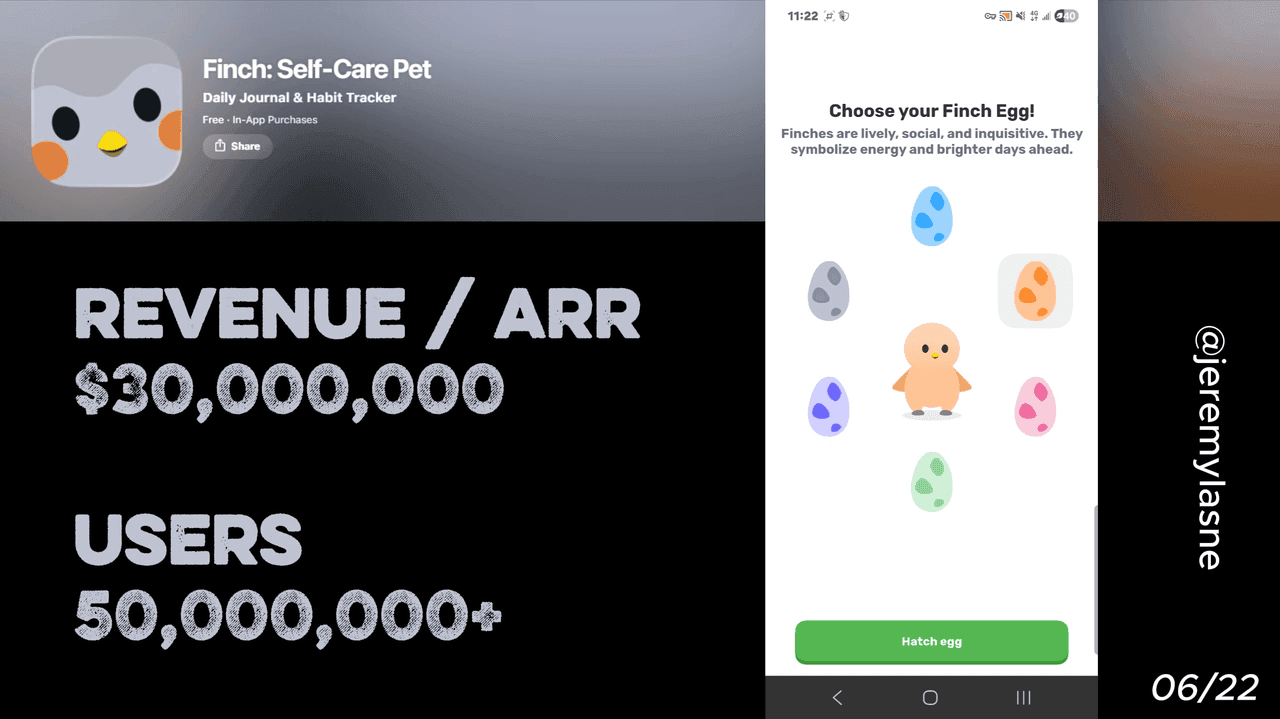
Finch is a self-care habit tracker that reframes your goals as care for a virtual pet bird. It has $30M ARR, 50M+ users, and was built without VC funding. Their onboarding is 28 screens. It starts not with a feature list but with the hatching of a pet, instantly framing the experience around nurturing. The paywall is a soft 7-day free trial. The streak mechanic is not about your consistency, it is about your bird's energy. This article breaks down every screen and the mechanism underneath.
The Numbers
The headline figures behind the teardown:
- ARR: $30M
- Total users: 50M+
- Monthly downloads: ~600K
- VC raised: $0
- Onboarding screens: 28
Finch hit $30M ARR without VC money. No institutional funding. No acquisition. A self-care app about a cartoon bird that outperforms most funded wellness competitors on retention and revenue per user. The reason is in the onboarding.
The Full Finch Onboarding Breakdown
Screen 1: Pick your egg
Finch does not open with a value proposition. It does not show you feature screenshots or user counts. It shows you an egg and asks you to choose one.
The onboarding immediately has you hatch, name, and choose a personality trait for your pet, creating a sense of ownership and responsibility from the very beginning.
You pick the egg. The egg hatches. You are now holding something.
That is the entire conversion mechanism of Finch, compressed into the first 60 seconds. Everything after, the personalization, the paywall, the streak, the widget, is in service of the thing that just happened: you became responsible for a living character.
No other onboarding move in the app matters as much as this one.
You name it. You choose its personality.
After hatching, you give your bird a name and a personality trait. Curiosity. Compassion. Logic. Creativity.
The full first-run flow runs: welcome → egg picker → phone verify → pronouns + name + trait → self-care primer + quiz → survey → paywall → attribution → buddies and contacts prompt → streak commitment → widget prompt → Home.
Naming is a commitment mechanism. The moment a user gives a character a name, the relationship is real. It is the same reason every mobile game has you name your character before the tutorial. The name makes the loss of the character feel personal. Finch builds this into the first minutes.
Notification permission: framed around the bird, not the app
Finch asks for notification permission early. But the framing is not "allow notifications to stay on track." The implied message throughout the flow is: your bird misses you when you are not here.
That reframe changes the nature of the permission ask entirely. You are not granting an app permission to interrupt you. You are making sure your bird knows when you are coming back.
The widget tells you that adventures are "in progress" or "completed" when ready, making appointments visible throughout the day without constant notifications. The notification system is designed around the bird's lifecycle, not the user's habit calendar. That distinction is why people actually keep them on.
Personalization: support areas, energy levels, life check-in
The survey covers ABOUT YOU / ENERGY / HOW'S LIFE / SUPPORT AREAS categories. The questions feel more like a therapist's intake form than an app quiz. Sleep habits. Energy patterns. Areas of life that feel hard. Things you want support with.
The extensive quiz uses large, tappable cards, making it easy to gather detailed personalization data without feeling like a chore.
The result is a starter plan that feels built for the specific user. Not generic "drink water, exercise more" defaults, actual goals surfaced from what they said they struggle with. After setup, recommended goals might include things like flossing each day, drinking water, having a daily stretch break, and doing one thing that makes you happy.
The paywall: soft, after the bond is built
Finch presents a soft paywall during onboarding, after demonstrating value through the personalization quiz. It offers a 7-day free trial for its Finch Plus subscription, using a timeline visual to clearly communicate when the trial ends and billing begins, which builds trust.
The sequencing is everything. The paywall appears after: you have a bird, you named it, you chose its personality, you told the app your deepest self-care struggles, and you have a personalized plan. At that point you are not being asked to pay for a subscription. You are being asked to keep everything you just built.
The 7-day free trial removes the last friction point. There is no price decision right now. There is only a question: do you want to keep going?
Post-paywall: attribution, streak commitment, widget
After the paywall, Finch asks where you heard about them. Then they ask for a streak commitment, not an automatic enrollment, but a deliberate choice: "I will take care of myself every day." Then the widget prompt.
The streak commitment and widget prompt come after the paywall in the flow. This sequencing is deliberate. Both asks are about retention, not conversion. They happen after the user has decided to stay, so the intent is already there. A streak commitment made voluntarily, after a decision to continue, is a stronger behavioral anchor than one made at install before the user has any investment.
The streak mechanic: not about you, about the bird
Traditional habit apps lean on streaks, which can curdle into guilt the moment you slip. Finch flips the motivation: your bird benefits when you take care of yourself, so self-care becomes an act of care rather than a performance.
This is the core product insight. Streaks fail in most habit apps because breaking them feels like failure. Guilt does not drive re-engagement, it drives avoidance. People who break a streak are the most likely to uninstall.
Finch removes the guilt by shifting the subject. You are not failing your streak. Your bird is losing energy. That is a different emotional experience, and it produces different behavior.
The app includes goals as foundational as "get out of bed," and it treats that achievement with the same celebratory animation as finishing a major project. Each completion earned rainbow stones to buy outfits for the bird or furniture for its house.
Every goal completed fills the bird's energy bar. Once the energy bar is full, the bird goes on a 6-hour adventure through Finchie Forest and comes back with a discovery to share. That is the reward: seeing what your pet found. The loop is: care for yourself → bird gets energy → bird goes on adventure → bird comes back changed. Your self-care has visible consequences for someone who depends on you.
The free tier: genuinely good by design
The free version is actually usable. You can raise your pet, complete basic tasks, and get daily affirmations. Premium unlocks extra customization, additional item slots in shops, and more time options. This is the opposite of hard paywalls that gate everything. It works because the free experience is genuinely good, users upgrade because they want more, not because they are forced.
This is an unusual choice in the subscription app landscape and it is a calculated one. A free tier that is genuinely good builds the habit first. The habit builds the attachment to the bird. The attachment to the bird creates the willingness to pay. Forcing the paywall too early cuts off the loop before the attachment forms.
The Core Mechanism
Many people struggle to do healthy things for themselves but will reliably do them for someone, or something, that depends on them. Finch borrows that motivation without any of the shame that creeps into streak-obsessed habit apps.
That single insight is the product. Every screen, every mechanic, every retention lever in Finch is downstream of one reframe: you are not trying to be consistent for yourself. You are taking care of something that needs you.
The onboarding creates the dependency relationship in the first 60 seconds, the egg, the name, the personality. The streak mechanic sustains it daily. The widget puts the bird on your home screen so it is present even when the app is closed. The adventure loop gives the bird a life that unfolds when you are not watching.
By day 7, the bird is not a feature. It is a responsibility.
What This Means for Your App
One question: who or what does your user feel responsible for inside your app?
If the answer is "themselves", their streak, their goals, their progress, you are fighting against the same motivation problem every habit app fights. People are bad at sustained self-discipline. They are good at not letting things they care about down.
Finch does not try to make people more disciplined. It redirects existing capacity for care, the same thing that makes people reliable for their children, their friends, their pets, and points it at a virtual bird. The self-care follows automatically.
You do not have to build a pet app. But you can ask: is there a way to make your user feel responsible for an outcome that is not just about them? A community, a streak that affects a group, a character that grows when they do?
The answer to that question is worth more than any paywall optimization.
FAQ
How many screens does Finch's onboarding have?
Finch's onboarding runs 28 screens, covering egg selection, hatching, naming, personality trait choice, pronouns, personalization survey, paywall, attribution, streak commitment, and widget prompt before landing on the home screen.
What is Finch's paywall structure?
Finch uses a soft paywall with a 7-day free trial for the annual Finch Plus subscription. The paywall appears after the personalization quiz, once the user has already hatched and named their bird. A timeline visual shows exactly when the trial ends and billing begins.
How does Finch's streak mechanic work?
In Finch, streaks are tied to your bird's energy bar rather than a personal consistency counter. Completing daily goals fills the bird's energy. When full, the bird goes on a 6-hour adventure and returns with discoveries. Missing days drains the bird's energy, not your streak number, which removes the guilt that makes traditional streak apps churn users.
What is Finch's revenue in 2026?
Finch has approximately $30M ARR as of 2026 with 50M+ total users and around 600K monthly downloads. The company built this without venture capital funding.
Is Finch free to use?
Yes. Finch has a genuinely usable free tier that includes pet raising, daily tasks, and basic exercises. Finch Plus unlocks additional customization, more shop slots, extended soundscapes, and advanced breathing options. The free tier is designed to be good enough to build the habit before the premium upsell.
Why does Finch ask you to hatch an egg at the start of onboarding?
The egg hatch is the core conversion mechanism of the entire app. By having the user pick, hatch, name, and assign a personality to the bird before any features are shown, Finch creates an emotional ownership bond in the first 60 seconds. Every subsequent retention mechanic, the streak, the adventure, the widget, depends on that bond existing first.
What makes Finch one of the best mobile app onboarding examples?
Finch creates emotional investment before showing any features, reframes self-care as care for something else, uses a shame-free streak system tied to a character rather than personal discipline, and times its soft paywall after the bond is already formed. The result is retention driven by attachment rather than guilt, which is significantly more durable.
This teardown is part of an ongoing series on in-app optimization. Want answers like these while you build? The tasu MCP serves the same sourced benchmarks to your coding agent, for onboarding, paywalls, and pricing.