42 screens that rank your identity
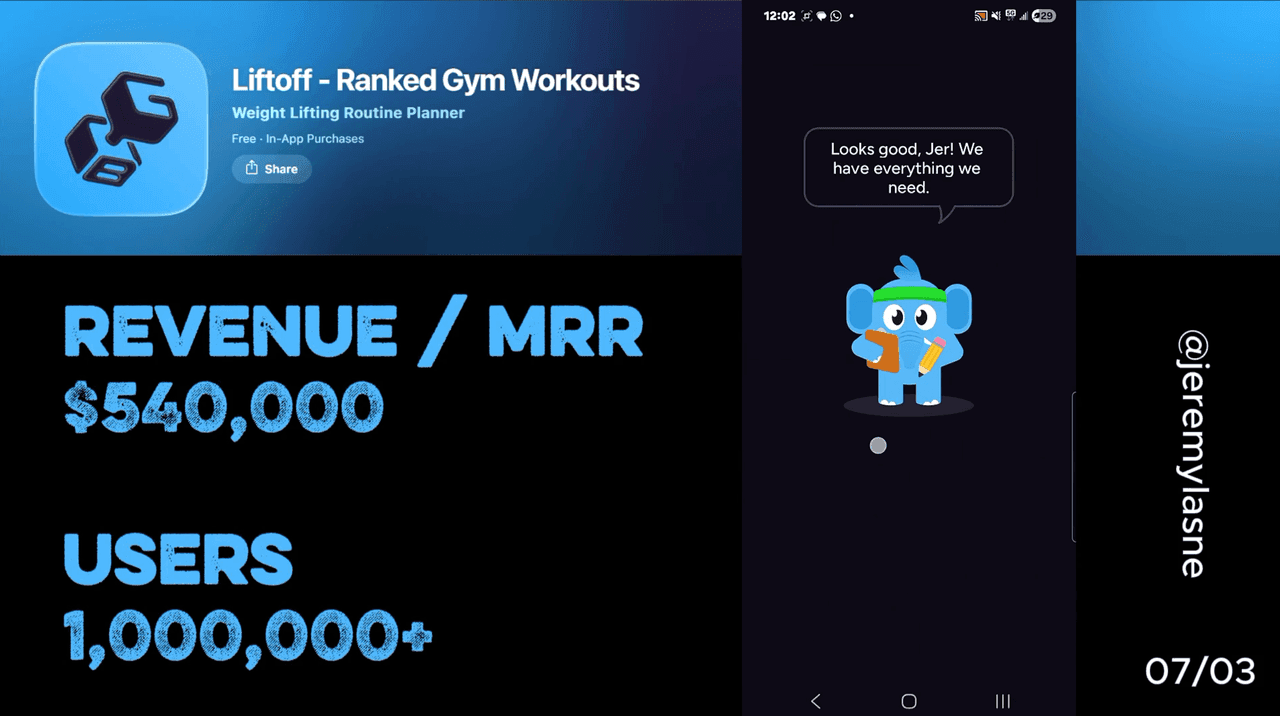
Liftoff is a gamified gym tracker built by Jason Lin while he was in college. It generates $500K in monthly iOS revenue with 200K monthly downloads, 1M+ active lifters, and a 4.7-star App Store rating. Their onboarding runs 42 screens. It opens with an elephant mascot, introduces the ranking system before any tracking feature, has the user hold the screen to commit, build a personal avatar, earn their first rank through simple questions, and hit a looping paywall with no exit button -- only a "Try free for 7 days" CTA that reappears every time the user tries to close it. This is the full breakdown of the most identity-driven onboarding in the series.
The Numbers
- Monthly iOS revenue: $500K
- Monthly downloads: 200K (iOS) + 30K (Android)
- Total lifters: 1M+
- App Store rating: 4.7 stars
- Exercises covered: 400+
- Founder: Jason Lin, built as a college student
- Distribution: zero paid ads, pure TikTok organic
- Onboarding screens: 42
Why the Ranking System Is the Whole Business
Liftoff didn't chase a market -- it scratched a personal itch. Jason grew tired of tracking workouts on random spreadsheets or outdated apps that didn't cater to his needs. The result is $500K/month from a product whose entire positioning is one sentence: your gym performance deserves a rank.
Every other fitness app in 2026 tracks what you do. Sets, reps, calories, body fat, sleep, HRV. Liftoff tracks where you stand.
The distinction is not a feature difference. It is a category difference. Tracking data produces information. A ranking system produces identity. And identity is stickier than information by orders of magnitude.
People don't go to Liftoff because they need another workout tracker. They stay because it feels like their tracker. For lifters. By a lifter. You're not logging reps -- you're leveling up your gym persona.
The 42-screen onboarding exists to install that identity before the user ever opens a workout log. By the time the paywall appears, the user is not deciding whether to subscribe to a fitness app. They are deciding whether to abandon the ranked gym persona they just spent 42 screens building.
The Full Liftoff Onboarding Breakdown
The elephant mascot: Duolingo energy in a gym
Liftoff opens with an animated elephant mascot. The character is warm, energetic, and celebratory -- Duolingo's owl translated into a gym context.
The mascot is not decoration. It is the emotional register of the entire onboarding. Gym apps are usually serious: clinical designs, black and dark interfaces, performance-first aesthetics. Liftoff uses a cartoon elephant because the product is built on the insight that fun and gamification drive consistency better than data alone.
The mascot signals immediately: this is not a spreadsheet with a fitness category. This is a game you play at the gym. That tone must be set on screen one, before the user has formed expectations based on what every other fitness app looks like.
Ranking introduced before tracking
Before Liftoff mentions a single tracking feature, it introduces the rank system. The framing is specific: "You're about to get your first rank." Not "start tracking your workouts." Not "log your first exercise." A rank. Something to earn. Something to hold.
This sequencing is the most important product decision in the entire onboarding. By presenting the rank before the tracker, Liftoff reframes the entire purpose of the app. The user is not adopting a logging tool. They are entering a progression system. Logging is what you do to climb the ranks, not the reason you're here.
Traditional fitness apps track your data. Liftoff rewards your effort. Progress is visual. Feedback is instant. Motivation compounds. That's the same psychology that makes games stick.
Introducing the reward before the behavior is the correct sequence for habit formation. Behavioral science consistently shows that establishing the reward first increases the likelihood of adopting the behavior that earns it. Liftoff's onboarding is built on this principle from screen two.
Mascot reacts to every personalization answer
As the personalization questions unfold -- training frequency, main goal, current level, preferred exercises -- the elephant mascot reacts to each answer. An ambitious goal triggers a celebration animation. A beginner level selection triggers a supportive, encouraging response. A specific exercise preference triggers excitement.
This is BitePal's raccoon mechanic, executed in a gym context. Each mascot reaction does two things: it maintains engagement across 42 screens that would otherwise feel like a long form, and it makes the user feel that the mascot has an opinion about their fitness journey. By screen 20, the elephant is not a UI element. It is a training partner with a personality.
The practical conversion effect is retention across the flow. Completion rates drop when onboarding feels administrative. The mascot makes 42 screens feel like a 42-exchange conversation with an enthusiastic gym buddy.
Hold the screen to commit: the physical gesture
Mid-onboarding, Liftoff presents a commitment screen. The instruction: hold the screen for a few seconds. The user presses and holds. A progress animation plays. The commitment is confirmed.
This is the most physically engaging commitment device in the series. Prayer Lock has the finger signature. Flo has the biometric hold. Liftoff has the sustained press.
The distinction from a tap is neurological. A sustained physical action -- holding something, maintaining pressure -- produces a stronger sense of completion and commitment than an instantaneous gesture. The user's body is engaged, not just their thumb. The duration creates a moment of deliberate intention that a single tap cannot replicate.
Small interactive steps before the paywall increase emotional investment and reduce drop-off. Liftoff's hold gesture is the highest-intensity version of this principle: not a checkbox, not a tap, but a sustained physical declaration that costs the user actual seconds of deliberate engagement.
Avatar creation: the gym persona becomes visual
After the commitment hold, Liftoff has the user build an avatar. Appearance choices, gear selection, visual customization. The user's ranked gym persona gets a face.
Avatar creation is the deepest investment in identity of any onboarding in this series. A name is yours. A signed commitment is yours. An avatar is you. The visual representation of the gym persona compounds every subsequent screen's emotional weight -- the user is no longer building an account, they are building a character that will represent them in leaderboards, friends' feeds, and the global ranking system.
Liftoff is a social platform where you can connect, compete, and share your fitness journey with friends and other gym-goers. The avatar is the social asset. Before the user has logged a single set, they have a visual identity in a community of 1 million lifters. Closing the app now means abandoning a character, not just an app.
Notifications: mandatory, framed as a deal
Liftoff asks for notification permission. The framing is not "can we send you reminders?" It is "notifications are how lifting becomes a habit." Not a request. A mechanism explanation.
The ask lands as a component of the system the user is joining, not a permission they are granting. You would not join a ranked game and then turn off the score updates. The notification framing positions reminders as fundamental to the ranked progression system, not as a marketing channel.
Timing the ask after the commitment hold and avatar creation is precise. The user has already made two physical investments in the experience. Saying no to notifications at this point would be inconsistent with the commitment they just made -- a psychological tension that the "yes" resolves.
Referral ask mid-onboarding
Before the first rank is assigned, Liftoff asks the user to invite friends. The framing is mutual benefit: bring someone along, earn rewards together.
Placing the referral ask before the rank assignment is calculated. At this point in the flow, the user has made the commitment gesture, built their avatar, and been introduced to a social ranking system. The referral ask lands in a social context -- you are not just joining an app, you are joining a leaderboard where your friends' presence makes it better. "Invite a friend" in that context reads as "make this more fun" rather than "do our marketing for us."
At 200K monthly downloads with zero paid advertising, referral and TikTok organic are Liftoff's entire acquisition engine. Liftoff has nailed TikTok as a distribution channel. They've created multiple TikTok accounts and post content regularly across all of them. Many of their videos consistently rack up millions of views. The mid-onboarding referral ask is the in-product extension of that organic growth machine.
First rank assigned through simple questions
After the personalization sequence, Liftoff assigns the user their first rank based on their answers. Bronze. Silver. Gold. The rank appears with a visual reveal -- the kind of moment a game saves for a level-up cutscene.
The assigned rank is the most important screen in the entire flow for one reason: it makes the abstract concrete. The ranking system, explained across multiple screens, becomes real the moment a specific rank appears with the user's name attached to it. The user is now a Bronze II lifter, or a Silver I, or wherever they land.
That specific identity -- "I am currently a Bronze II" -- is what the paywall is protecting. Closing the app means abandoning a ranked position the user has just received, not closing an onboarding flow.
Loading screen + mid-personalization review ask
As the personalization plan compiles, Liftoff shows a loading screen. Mid-personalization, while the elephant animates and the plan builds, the review ask appears -- with the star rating displayed simultaneously.
The co-presentation of the review request and the rating is unusual and precise. The user is being asked to rate the app while simultaneously being shown that 4.7 stars is already the social norm. The social proof creates the anchor: the expected review is five stars, and the positive emotional state during loading makes it natural to comply.
Capturing ratings at peak emotional investment, before any paywall friction, produces higher scores than asking after a commercial interaction. Liftoff captures the review during the plan-building animation -- arguably the highest-anticipation moment in the entire flow. The user is about to see their rank for the first time. They are at peak excitement. That is when the rating appears.
Rank explained as identity, not metric
Before the paywall, Liftoff shows screens explaining how the rank system works in practice. Not just in the app -- in life.
Your rank is a reflection of your training consistency. It affects how your friends see your progress. It shows up on leaderboards. It represents who you are as a lifter, not just what you lifted last Tuesday.
"Hitting Gold 1 felt like a genuine achievement. The ranking system provides that extra 5% of motivation to push through a heavy set when I'd usually quit." -- App Store review
This is Liftoff making the rank feel like a real-world identity marker, not a gamification layer. The user who understands that their rank is visible to their community, represents their training commitment, and reflects their progression over time is in a fundamentally different relationship with the product than the user who just sees a colored badge.
The rank is the thing you are paying to develop and protect. The paywall reveals that on the next screen.
The paywall: no skip, trust built before the ask
The paywall arrives with no exit button. The only CTA is "Try free for 7 days." No "maybe later." No "continue free." One direction: forward.
Before the actual billing screen, Liftoff shows one additional screen: "We'll remind you 3 days before your trial ends." No surprise charges. No forgotten subscriptions. Just a direct promise that the user will be notified before any money moves.
This trust-building screen before the billing confirmation is the highest-ROI single screen in the paywall sequence. Hard paywalls convert at more than five times the rate of freemium models, but they also produce the highest charge dispute rates when users feel surprised by the billing. Liftoff's "we'll remind you" screen preempts that objection entirely, converting the trust resistance into reassurance before the card details are requested.
The structure: commitment to notify → actual paywall → annual plan positioned as obvious choice. Three screens that move from emotional reassurance to commercial action without a friction spike.
The loop: close the paywall, it comes back
If the user closes the paywall, Liftoff does not show a discounted offer. It does not show a surprised mascot. It loops back to the "Try free for 7 days" screen.
The same screen. The same CTA. The same offer.
This loop is the most elegant paywall architecture in the series, and it is ruthless in its simplicity. There is no escape path that does not involve either starting the trial or putting the phone down entirely. Every attempt to exit the paywall is met with the same invitation: try it free for seven days. The user is not fighting a sales machine. They are being repeatedly offered a no-cost trial.
Post-close welcome offers that appear after the onboarding paywall is dismissed are now standard. Liftoff does not show a different offer on close. They show the same one -- which means there is no signal to the user that closing will produce a better deal. Waiting yields nothing. The price does not move. The only move available is the trial.
The loop converts users who needed a moment to think but did not need a discount. That is a specific and valuable segment: the hesitant but interested, not the price-sensitive. Liftoff's loop captures them without diluting revenue for the users who would have taken the original offer.
The Core Mechanism
Liftoff's conversion is built on one insight that no other fitness app in this series executes: rank the person, not the workout.
Every screen in the 42-screen onboarding builds a specific ranked identity for the user. The mascot validates it emotionally. The commitment hold makes it physical. The avatar makes it visual. The first rank assignment makes it real. The rank-in-life explanation makes it social. By the time the paywall appears, the user is not deciding whether to subscribe to a workout tracker. They are deciding whether to continue developing a ranked fitness identity that now exists in a community of 1 million lifters.
The paywall loop closes that decision without offering an escape. The trust screen removes the last objection. The annual plan is the obvious choice for someone who has just committed to a long-term rank progression.
This is the deepest identity-based conversion in the series. Prayer Lock converts on declared faith identity. Finch converts on parental responsibility. Liftoff converts on competitive self-image. All three work for the same reason: you cannot close an app and also remain the person you described yourself as inside it.
What This Means for Your App
One question: does your product confer an identity, or just track behavior?
Tracking behavior produces data. Conferring identity produces belonging. MyFitnessPal tracks your calories. Liftoff ranks your commitment. The user who abandons MyFitnessPal loses data. The user who abandons Liftoff loses a rank. Those are not the same loss.
Three lessons from Liftoff's 42-screen playbook
- Introduce the reward before the behavior. Liftoff shows the rank before the workout log. The payoff must precede the habit if you want the habit to form. Whatever your app's core reward is, name it on screen two -- not after the user has already done the work.
- A looping paywall only works if the offer is genuinely fair. Seven days free is a real offer. A loop that keeps returning a manipulative or confusing paywall creates frustration. Liftoff's loop works because "try free for 7 days" is an objectively reasonable CTA that most users have no actual argument against. The loop just makes sure they see it until they make a decision.
- The trust screen before the billing screen is worth more than any discount. "We'll remind you before your trial ends" costs Liftoff zero revenue and removes the single biggest emotional barrier to starting a trial -- the fear of being charged unexpectedly. Ship this screen. It is the cheapest paywall optimization in this entire series.
FAQ
How much does Liftoff make per month?
Liftoff generates approximately $500K in monthly iOS revenue with 200K monthly downloads as of 2026. Combined with Android, monthly revenue exceeds $540K.
How many users does Liftoff have?
Liftoff has over 1 million active lifters and maintains a 4.7-star App Store rating. The app was built by GymBros Inc., founded by Jason Lin while he was a college student.
How many screens does Liftoff's onboarding have?
Liftoff's onboarding runs 42 screens covering mascot introduction, rank system presentation, personalization with mascot reactions, hold-to-commit gesture, avatar creation, mandatory notification framing, referral ask, first rank assignment, plan-building loading screen, review ask with 4.7-star display, rank-in-life explanation, and a looping paywall sequence.
What is Liftoff's paywall structure?
Liftoff uses a hard paywall with no skip or exit button. The CTA reads "Try free for 7 days." A trust screen appears before the billing confirmation promising a reminder 3 days before trial end. If the user closes the paywall, the flow loops back to the "Try free for 7 days" screen. The loop continues until the user either starts the trial or exits the app entirely.
What is Liftoff's ranking system?
Liftoff assigns workout performance ranks -- Bronze, Silver, Gold, and beyond -- based on consistency and exercise performance across 400+ tracked exercises. The rank is visible to friends, appears on global leaderboards, and is positioned as an identity marker rather than a data point. Users earn XP per workout, level up through rank tiers, and can collect cosmetic rewards through eggs earned in quests.
Why does Liftoff use an elephant as a mascot?
The elephant mascot establishes a warm, gamified, Duolingo-like emotional tone that distinguishes Liftoff from the clinical, performance-focused aesthetic of traditional gym apps. The mascot reacts to personalization answers throughout onboarding, creating a conversational dynamic that maintains engagement across 42 screens and builds emotional connection before the user has logged a single workout.
How did Liftoff grow without paid ads?
Liftoff acquired its 1M+ user base through organic TikTok content across multiple accounts, posting relatable gym content that consistently generated millions of views. The in-onboarding referral ask captures additional organic growth from existing users at peak engagement, compounding the TikTok-driven discovery with word-of-mouth conversion.
This teardown is part of an ongoing series on in-app optimization. Want answers like these while you build? The tasu MCP serves the same sourced benchmarks to your coding agent, for onboarding, paywalls, and pricing.