570K downloads on the Flo playbook, clinical-grade features given away free, and the ad inside the medication alarm where the revenue model should be
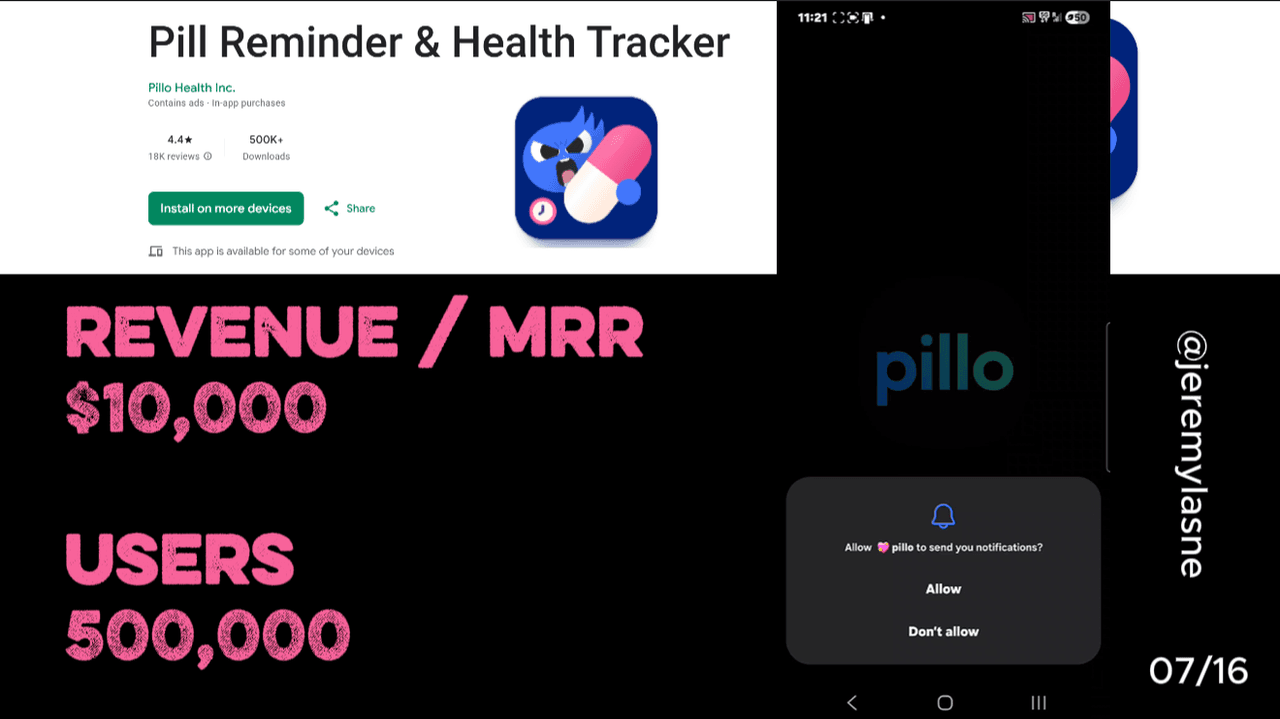
Flo made $275 million from subscriptions in 2025 by building the deepest, most trusted women's health app on the market. Pillo is running the same category playbook -- deep feature set, strong emotional character, genuine clinical utility -- but scoped specifically to medication adherence. 570K downloads. 4.76 stars. Top 100 medical apps. Drug interaction checker, caregiver alerts, charity donations tied to compliance streaks. No visible paywall. Ads appearing in the medication alarm. The product is ready. The revenue model is not. This teardown is about the gap between what Pillo built and what it could charge for.
The Numbers
- Downloads: 570K total (the Play Store listing shows 500K+)
- Monthly installs: 24K, averaging ~810/day
- Rating: 4.76 / 5 across 17K reviews (as of 2026)
- Rank: Top 100 medical apps on Google Play
- Developer: Pillo Health Inc.; the listing reads "Contains ads · In-app purchases"
- Revenue: ~$10K MRR estimated, against 570K downloads
- Model: core features free (unlimited medications, persistent alarm, medication log, drug interaction checker, caregiver alerts); a yearly premium exists but is not surfaced; ads introduced in-product
- Onboarding: notification permission asked first, alarm-sound choice during setup, then a 7-step guided tour (skippable after a few steps)
- Retention mechanic: HEART points donated to charity at 100% adherence compliance
The Flo Parallel
Flo did not win by being a period tracker. It won by becoming the most trusted platform for women to understand their own bodies -- a space where 77 million active users share intimate health data because the product made them feel understood, safe, and in control.
The revenue followed from the trust. Users who share their cycle data, their symptoms, their moods, their medical history inside an app do not want to lose that history. The subscription is not a paywall. It is protection of something the user built.
Pillo is running the same play in a different niche.
Medication adherence is arguably more intimate than cycle tracking. The medications someone takes, the conditions they are managing, the missed doses they are too embarrassed to tell their doctor about -- this is health data at its most personal. And Pillo has positioned itself as the safe place for it: privacy-first, data stays on-device, no registration required, no paywall on core features.
The trust architecture is the same as Flo's. The monetization has not been built yet.
The Mascot: Stubborn in the Right Way
Flo has a battery mascot that represents energy and health cycles. Pillo has a tiny character described officially as "stubborn and caring" -- a character who genuinely cares whether you took your meds.
The stubborn framing is precise and medically appropriate. Most wellness app mascots are gentle and encouraging. Pillo's is persistent by design because the core feature is persistent -- an alarm that does not stop until you respond. The character's personality matches the product's mechanism. That kind of coherence between mascot and core feature is rare and it is why Pillo's onboarding works emotionally even at low screen count.
The non-skippable animation at open does what Flo's opening does in a different register: it establishes the relationship before the product starts. You are not entering a utility. You are meeting a character who is going to be responsible for your health routine. That framing changes what the product means to the user -- and therefore what they will pay to keep.
The Onboarding: Short, Sharp, One Missed Moment
Notification permission asked immediately. The right call -- this is a medication alarm. Every other onboarding in this series delays the notification ask until investment has been built. Pillo asks first because the notification is the product. You cannot use a medication alarm without agreeing to be alerted.
Personalization follows: medications, schedule, routine. The alarm sound personalization is the most thoughtful detail in the flow. You choose your own alert sound during setup. Not in settings. During setup. Because the sound that gets you to respond to your alarm matters and Pillo wants you to choose it before the habit is formed.
Loading screen acknowledgment. More permissions for health data. Into the guided tour -- 7 steps, skippable after a few.
What is missing: one first-dose completion before the tour ends. Walking the user through adding their first medication, setting their first alarm, and confirming the reminder -- the full loop, completed once, inside onboarding -- would produce meaningfully higher Day 1 engagement. A user who leaves onboarding having already configured one medication is invested. A user who watched a tour and left is not.
Settings are settings. No review surface. No share prompt. At 570K downloads driven mostly by organic discovery through strong ratings, this is a growth flywheel running at half speed.
The In-App Experience: Clinical Depth at Zero Cost
This is where Pillo diverges most sharply from Flo's model -- and where the revenue gap becomes most visible.
Flo charges for insights. The premium tier adds AI analysis, detailed cycle predictions, medical content, and expert consultations. The free tier gives you tracking. The paid tier gives you understanding.
Pillo gives you almost everything free:
- The persistent full-screen alarm that won't stop until you respond
- The complete medication log with dose history
- The drug-drug interaction checker using FDA data
- The food interaction alerts, supplement interaction warnings, and drug allergy checker
- The side effects reference and nutrient depletion alerts
- The caregiver SMS system where a family member is notified if you miss a dose
- Blood pressure, glucose, weight, and mood tracking
- The driving safety mode
- HEART points donated to charity at 100% adherence compliance
The caregiver alert system alone is a feature that eldercare monitoring services charge EUR 20-30/month for. Pillo gives it away.
This generosity is both the product's greatest strength and its clearest strategic vulnerability. It built 570K downloads and a 4.76 rating. It also made the premium subscription invisible because there is almost nothing left to put behind it.
The Monetization: Almost Invisible, Then Suddenly Jarring
The premium subscription exists. A yearly plan is confirmed in developer responses to reviews. It is not surfaced in the main flow, not highlighted in onboarding, not presented with any clarity about what it unlocks. Users who want it have to go looking.
The revenue has to come from somewhere. It came from ads.
Ads introduced as a monetization mechanism. Not as a clearly disclosed ad-supported tier upfront. As interruptions that appeared in the product. Including, based on a recent review, inside the medication alarm itself -- replacing the calming sound the user specifically chose during onboarding with audio from an advertised mobile game.
This is the most significant trust violation documented in any teardown in this series.
The onboarding specifically gave the user agency over their alarm sound -- a signal that this app respects the intimacy of a medication reminder. An ad replacing that sound says the opposite of everything the mascot communicated. The stubborn little character who "genuinely cares whether you took your meds" cannot coexist with an ad delivery system that treats the medication alarm as an impression slot.
Flo's $275M is built on users feeling their health data is safe and the product has their best interests in mind. The ad-in-the-alarm is the exact opposite of that. It is the moment where the Flo parallel breaks.
What the Revenue Model Should Be
Pillo has three premium features that users would pay for without experiencing the payment as a breach of trust. None of them require removing anything currently free.
Caregiver Pro
The SMS alert system for caregivers -- a family member notified of missed doses -- is professional-grade eldercare monitoring. Families managing an aging parent's medication schedule would pay EUR 7.99-9.99/month for this. It is the right feature, priced correctly for the person paying: not the patient, but the adult child or caregiver who is responsible for that patient's adherence.
Safety Pro
The full clinical safety toolkit -- drug interactions, food interactions, supplement warnings, nutrient depletion, allergy checker -- bundled as a premium tier at EUR 3.99-4.99/month. The free tier keeps basic reminders. The paid tier adds the analytical layer that turns Pillo from a reminder app into a medication management tool. This is Flo's insight applied to medication: the tracking is free, the understanding costs money.
Ad removal
A simple EUR 1.99/month subscription that removes ads. Priced below any psychological threshold for comparison shopping. For users who experienced the alarm interruption, this is not a price evaluation. It is relief. The conversion rate on "pay EUR 2 to restore the calming sound you chose" is not a paywall conversion problem. It is a trust restoration transaction.
These three tiers together form the revenue architecture Pillo needs: a family/professional tier for caregivers, a clinical insights tier for power users, and an ad removal tier for everyone who had a bad ad experience. None of them touch the free core. All of them serve a genuine user need.
The HEART Points System: The Most Underrated Retention Mechanic in the Series
At 100% medication compliance, Pillo donates HEART points to charity.
This mechanic deserves more attention than it gets. Every other retention mechanic in this series is self-referential: streaks keep you coming back for the streak, ranks keep you coming back for the rank, mascots keep you coming back for the relationship. HEART points keep you coming back because compliance produces a real-world outcome that benefits someone else.
The identity this creates -- "I take my medications every day and it helps other people" -- is more durable than any gamification loop in this series. It is also the most medically appropriate framing possible. Consistent medication adherence is a genuine health intervention. Pillo makes that intervention feel like contribution rather than discipline.
Flo's equivalent is the community layer: 77 million women sharing a platform, producing the network effect that makes the app feel like a social good rather than a subscription service. Pillo's equivalent is smaller but structurally similar: your daily compliance has an output beyond yourself.
This is a premium feature in disguise. A "Champion" tier at EUR 4.99/month that multiplies HEART points, gives the user visibility into where their donations go, and lets them choose their charity category would convert the most engaged users -- the ones who have been 100% compliant for 30 days -- at very high rates. They are already invested in the outcome. Paying to amplify it is a natural extension of that investment.
What Pillo Gets Completely Right
The niche is the right niche. Medication adherence is a $300 billion annual healthcare cost problem. Apps that solve it -- really solve it, not just nudge it -- are addressing something measurable and significant. Flo addressed cycle tracking because most women had no reliable tool. Pillo is addressing medication adherence because most reminder apps are too easy to dismiss.
The persistent alarm is the right product decision. The stubborn mascot is the right character decision. The privacy-first architecture is the right trust decision. The HEART points charity mechanic is the right retention decision. The clinical safety toolkit is the right depth decision.
Every core product decision is correct. The only incorrect decision is putting ads inside the alarm.
That one decision is what separates Pillo at 570K downloads with unclear revenue from Pillo at 570K downloads becoming the Flo of medication management.
Flo understood that $275M follows trust in intimate health categories. Pillo built the trust. The medication data, the alarm the user configured, the caregiver who relies on it -- these are the ingredients of a subscription people pay to protect. The revenue model just needs to match the product. Replace the ads with three tiers that serve genuine needs and the gap between 570K downloads and meaningful revenue closes fast. If you want to know which screen in your own funnel is quietly breaking that kind of trust -- and what it costs you -- tasu maps exactly that, ranked by dollar impact.
FAQ
How does Pillo compare to Flo?
Flo and Pillo share the same strategic architecture: deep, trust-based health data collection in an intimate category, with a mascot-driven emotional layer and a privacy-first positioning. Flo built $275M/year on women's cycle health. Pillo is building in medication adherence -- a category with comparable intimacy and larger systemic health stakes. The primary gap is monetization: Flo charges for its insights layer, Pillo gives most of its clinical features away free and monetizes through ads that undermine the trust the product was built on.
How many downloads does Pillo have?
570K total downloads, 24K monthly installs averaging 810 per day. Top 100 medical apps on Google Play. 4.76/5 rating across 17K reviews as of 2026.
Is Pillo free?
Core features are free: unlimited medications, the persistent alarm, the medication log, the drug interaction checker, and caregiver alerts. A yearly premium subscription exists but is not prominently surfaced. Ads have been introduced as a revenue mechanism, including interruptions to the medication alarm itself.
What is the HEART points system?
At 100% medication compliance, Pillo donates HEART points to charity. The mechanic reframes consistent adherence as contribution rather than discipline -- making the daily habit loop serve an external benefit, which is a more durable motivation frame than streak numbers alone.
What should Pillo charge for?
Three natural premium tiers: Caregiver Pro for SMS alerts to family members managing a dependent's medication schedule (EUR 7.99/month); Safety Pro for the full clinical safety toolkit including drug interactions, food interactions, and nutrient depletion alerts (EUR 3.99/month); and a simple ad-removal subscription (EUR 1.99/month) for users who want to restore the experience the onboarding originally promised.
Why is Pillo's ad strategy a problem?
Pillo's onboarding specifically has users choose their own alarm sound -- a signal that the app respects the intimacy of a medication reminder. Ads appearing inside that alarm, replacing the chosen sound with game audio, directly contradict the promise the mascot makes: "I genuinely care whether you took your meds." The ad delivery system and the character's stated values cannot coexist without one undermining the other.
This teardown is part of an ongoing series on in-app optimization. Want answers like these while you build? The tasu MCP serves the same sourced benchmarks to your coding agent, for onboarding, paywalls, and pricing.