7.2M downloads, $70K/month, and the hard gate at lesson 3 that never lets users reach the aha moment
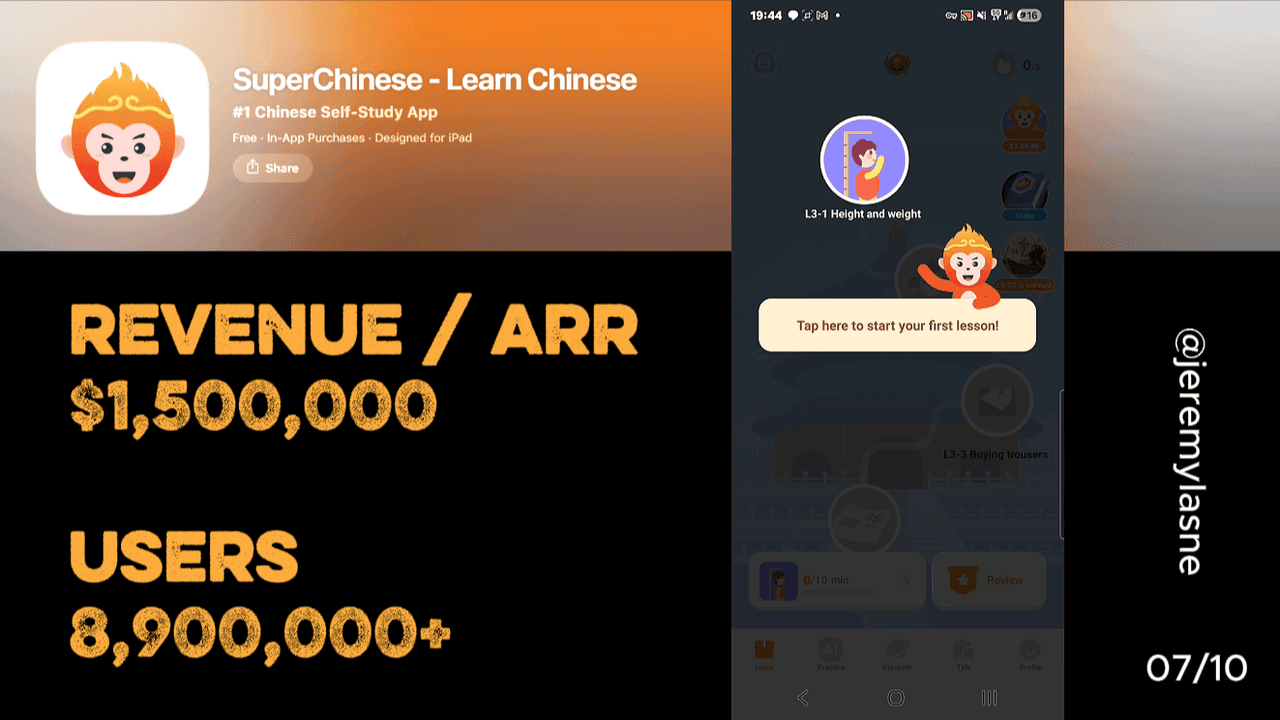
SuperChinese is a Mandarin Chinese learning app built by Shanghai Yuxuan Information Technology Co. with 7.2 million total downloads and $70K in monthly iOS revenue. In-app purchases range from $8.49 to $149.99. Their onboarding runs 15 screens. It opens with a monkey mascot -- a direct reference to Sun Wukong, the Monkey King -- then moves through quick personalization, a progress projection, and a notification ask framed as a commitment tool. Account creation is skippable. The paywall shows monthly, annual, and lifetime tiers with "exclusive for you, limited time" urgency framing, reviews embedded alongside the pricing, and heavy text density. The free tier gates at 2-3 lessons. This teardown maps where the revenue leaks and what fixing it would be worth.
The Numbers
- Total downloads: 7.2M
- Monthly iOS downloads: 10K
- Monthly iOS revenue: $70K
- In-app purchase range: $8.49 to $149.99
- App Store rating: 4.81 / 5
- Content: 400+ lessons, 9 levels, 50+ themes
- Onboarding screens: 15
- Free lesson gate: 2-3 lessons before hard paywall
- Developer: Shanghai Yuxuan Information Technology Co., Ltd.
The Revenue Gap That Tells the Whole Story
Duolingo generates $86M per month. SuperChinese generates $70K. Both are language learning apps. Both use AI. Both have millions of downloads.
The gap is not the product category. Mandarin Chinese is the most-studied non-English language globally and the hardest major language for English speakers to acquire. The demand for a great Chinese learning app is enormous and underserved. Users who find SuperChinese consistently describe it as superior to Duolingo for Chinese specifically -- better tones, better character recognition, better speech feedback.
The gap is the funnel. The conversion architecture between install and paid user is losing the majority of users who arrived motivated. This teardown maps where.
The Full SuperChinese Onboarding Breakdown
The monkey mascot: the right cultural reference, underused
SuperChinese opens with a monkey mascot. This is not a generic cute animal choice. The monkey is a direct reference to Sun Wukong -- the Monkey King from Journey to the West, one of the four great classical novels of Chinese literature and arguably the most recognizable character in Chinese cultural history. A monkey mascot for a Chinese learning app signals to anyone who knows the reference: this app understands the culture, not just the language.
That cultural precision is the strongest first-impression asset in the onboarding. It tells the user who came to learn Chinese because they are genuinely interested in the culture -- not just the utility -- that this app was built by people who share that interest.
The problem is what happens after screen one. The Monkey King is one of literature's most energetic, mischievous, and expressive characters. SuperChinese introduces a mascot with that cultural weight and then leaves it largely static for the rest of the onboarding. Sun Wukong reacting to your level selection, celebrating a correct answer, expressing impatience when you slow down -- that is not just cute mascot design. It is a cultural easter egg that deepens the immersion. The reference is there. The activation of it is not.
Compare this to Duolingo's owl, which appears constantly throughout onboarding and in-app. Or Liftoff's elephant, which reacts to every personalization answer. Or BitePal's raccoon, which responds to each food choice with visible emotion. SuperChinese has a mascot with more cultural depth than any of them. It just does not use it.
The fix is not to redesign the mascot. It is to give it more screens. The Monkey King reacts to your level selection. He celebrates when you set your goal. He shows impatience and energy when you pick an advanced path. He pulls out a staff and cheers when you commit to daily practice. Each reaction is a micro-relationship being built before the paywall appears -- and each one is also a cultural reference that deepens the user's sense that learning Chinese with this app is going to be different from anything else they have tried.
Quick personalization: efficient but thin
SuperChinese runs three to four personalization questions quickly. Why are you learning Chinese? Business, travel, cultural interest, academic, heritage connection. What is your current level? What is your learning goal -- casual conversation, professional fluency, HSK exam preparation?
The questions are the right questions. The problem is that they arrive and pass too quickly to build investment. The answers do not trigger visible animations, projected outcomes, or mascot reactions. They are collected and the onboarding continues.
Compare this to YarnPal's yes/no sequence, where seven binary questions each deposit a micro-commitment. Or Flo's alternating personalization and outcome screens. SuperChinese collects good data and does not show the user what their data is being used for until much later in the flow.
The fix is to make each answer visibly consequential. Level: beginner, and the learning path adjusts visually while the Monkey King nods encouragingly. Goal: HSK 4, and a specific exam milestone appears on a timeline. Motivation: business, and a sample business Chinese dialogue plays. Each answer should produce a visible output that makes the user feel the personalization is real, not a form being submitted somewhere.
Progress projection: the right screen, needs specificity
After personalization, SuperChinese shows a progress claim. Something to the effect of: based on your goal and level, you could hold a basic conversation in 90 days with consistent practice.
This is the right screen. Oniri does it with a graph. Cal AI does it with an animated plan generation sequence. Flo does it with a before/after visualization. SuperChinese does it with a text statement.
The text statement is the weakest version of this mechanic. A graph, with the user's specific goal, a named milestone date, and a visual projection line, converts better because it makes the claim feel specific to this user rather than generic to all users.
The fix is straightforward: replace the text projection with a simple graph or visual timeline. The user's name at the top. Their stated goal as the endpoint. Milestones at 30, 60, and 90 days. The data to generate this already exists from the personalization questions. The display is the only change. And if the Monkey King is pointing at the projection line looking excited, even better.
Notification ask: commitment framing, correctly done
SuperChinese frames notifications as a commitment tool rather than a permission request. The language is something like: notifications keep you on track, so you stay committed to your goal. The system prompt follows.
This is the correct framing. It mirrors Liftoff's "so lifting becomes a habit" and Flo's "we'll send you a warning if something looks unusual." The notification ask is tied to the user's stated goal rather than the app's retention mechanism.
The placement is reasonable -- after the personalization, when the user has a stated goal that the notification will support. The execution is functional. One optimization: the Monkey King appearing alongside the notification ask, looking expectant, makes the commitment feel personal to a character the user has already started to relate to.
Account creation: skippable, and correctly so
SuperChinese makes account creation optional. The user can skip it and continue as a guest.
This is the right decision. The hard lesson from Huckleberry is that mandatory account creation before first product experience bounces motivated users who have not yet felt the value. SuperChinese avoids that mistake. The skip option exists and the onboarding continues.
The one optimization: the account creation screen could do more to explain what an account protects. "Save your progress and sync across devices" is a better skip-or-proceed frame than a plain sign-up prompt. The user who knows what they are preserving by creating an account converts at higher rates than one who sees a generic registration form.
The Paywall: Three Good Problems in One Screen
SuperChinese's paywall is the most complex single screen in this teardown series. Three tiers. Multiple pricing lines. Urgency framing. Reviews. All on one screen.
Each problem deserves its own diagnosis.
Problem 1: "Exclusive for you. Limited time."
The urgency framing -- a percentage discount presented as exclusive and expiring -- is the most common paywall tactic in the Chinese-market app ecosystem. It works in China, where manufactured scarcity has a longer cultural history in commerce and where consumers are accustomed to seeing it on Taobao, JD.com, and every major e-commerce platform.
It reads differently in Western markets. Users who grew up with "SALE ENDS TONIGHT" email spam are trained to read "exclusive for you, limited time" as a default marketing frame that means nothing. Reviews criticize the pricing as expensive, which suggests the urgency framing is not reducing perceived price -- it may actually be increasing suspicion about the real price.
The fix for Western markets: replace "exclusive for you, limited time" with transparent pricing and a clear annual discount percentage. "Save 40% with annual" converts better in Western markets than "exclusive 40% off just for you." One is a deal. The other is a claim that requires trust the user does not yet have.
Problem 2: Three pricing tiers with lifetime
Monthly, annual, and lifetime on one screen creates the classic three-option paradox. The research across subscription app paywalls is consistent: two options convert better than three, and three convert better than four. Each additional option increases decision time and reduces the probability of any choice being made.
The lifetime option is particularly problematic positioned alongside monthly and annual. The lifetime price (up to $149.99) requires a calculation the user cannot easily make mid-onboarding: "is this app worth $150 forever?" That is a fundamentally different question than "is this app worth $X/month?" and it cannot be answered without first experiencing the product.
The fix: show annual vs monthly only at the first paywall. Surface the lifetime option as a secondary offer for users who have been active for 30+ days -- when they have data to support the "is this worth $150 forever?" calculation. Users who experience 30 days of genuine value and then see a lifetime option convert at meaningfully higher rates than users seeing it at install.
Problem 3: Reviews embedded in the pricing screen
The reviews on the paywall serve a real function -- social proof at the moment of the conversion decision. The problem is density. SuperChinese's paywall packs purchase options alongside reviews, urgency framing, and three pricing tiers on the same screen.
The user's eye does not know where to land. In the best paywalls in this series -- Cal AI's "$0.00" screen, Liftoff's clean "Try free for 7 days" -- there is one CTA and one message. The design directs attention. SuperChinese's paywall competes with itself.
The fix: separate the social proof from the pricing. Reviews go on the screen before the paywall -- the same sequencing Yazio, BitePal, and Prayer Lock all use. By the time the pricing appears, the social proof has already done its work. The paywall screen itself shows pricing, one primary CTA, and nothing else.
The Hard Gate After 2-3 Lessons: The Most Expensive Decision in the Product
After onboarding, users can access two to three free lessons before a hard paywall blocks all further content. Reviews criticize this directly: "Only the first two and a half units are free. To progress further, you need to pay a hefty amount of money."
This is the single most revenue-destructive decision in SuperChinese's product.
The user who downloads a Mandarin Chinese learning app is the highest-intent user in the language learning category. Chinese is the hardest major language for English speakers. Nobody downloads a Chinese learning app casually. They have a reason: a job opportunity, a relationship, a heritage they want to connect to, a trip planned. That motivation is the highest-value asset in the conversion funnel.
Two to three lessons is not enough to feel that motivation validated. It is not enough to experience the speech recognition, the character writing, the tonal feedback -- the features that users who convert consistently cite as the reason they pay. The aha moment for SuperChinese is not "I learned a word." It is "I actually said a Chinese sentence and it understood me." That moment requires more than 2-3 lessons to reach.
The hard gate before the aha moment is the paywall before the value -- the single most consistent predictor of failed conversion across the entire series.
The fix: extend the free tier to 10-15 lessons and include at least one complete speech recognition exercise and one complete character writing session. Let the user experience the two features that are genuinely better than Duolingo for Chinese. Then gate. The users who reach the aha moment convert at higher rates, pay more, and churn less.
The Cultural Context: Building a Western Paywall From a Chinese Product Team
This is the dimension of the SuperChinese teardown that does not apply to any other app in the series.
SuperChinese is built by a Shanghai-based team for a global audience. The design decisions -- the "exclusive for you" urgency framing, the dense multi-option paywall, the early hard gate -- are all patterns that perform well in Chinese mobile commerce. They are the standard architecture on Chinese app stores, where users are accustomed to heavy promotional framing, where lifetime options are common, and where hard content gates after a few free samples are an accepted norm.
In Western markets, these patterns land differently. The urgency framing reads as manipulative. The density reads as overwhelming. The hard gate reads as stingy. None of these are accurate descriptions of what SuperChinese offers -- the content is genuinely excellent and the price is fair -- but the framing creates resistance before the product has a chance to prove itself.
The Monkey King mascot is the one element that translates perfectly across both markets. Sun Wukong is recognized in China as a cultural icon and increasingly recognized in the West through films, games, and global media. A mascot with that cross-cultural resonance is worth investing in deeply. It is the one brand asset SuperChinese has that neither Duolingo nor any other language learning competitor can replicate.
This is not a criticism of the product team. It is a recognition that conversion architecture is culturally specific, and the most successful global apps from Chinese companies have all invested significantly in Western-market conversion testing to override their default patterns. SuperChinese's paywall would likely perform significantly better in its home market. For Western conversion, the changes needed are not product changes. They are cultural translation.
The Niche Advantage That Makes This All Worth Fixing
Users who find SuperChinese consistently describe it as knocking competitors out of the park for Mandarin specifically. The speech recognition is better than Duolingo's for tones. The character writing system is more rigorous. The AI proficiency test is genuinely precise. The content covers HSK levels through advanced professional Chinese.
No other app in this series has a clearer competitive moat. Duolingo's Chinese is widely criticized as inadequate for serious learners. Rosetta Stone is expensive and outdated. HelloChinese is shallow. SuperChinese is the only app that covers the full range from pinyin basics to HSK 6 professional Chinese with AI-powered pronunciation feedback.
The niche is the strength. The addressable market is every English speaker who wants to learn the world's most spoken language and is serious enough to need more than Duolingo's gamified surface coverage. That market is large, motivated, and underserved.
The revenue gap between $70K/month and what this product could generate is not a product gap. It is a conversion architecture gap. The same users who are downloading and bouncing would stay and pay if they reached the aha moment before the paywall. The Monkey King is waiting on screen one. He just needs to be let into the rest of the funnel.
The Fix Priority List
In order of estimated revenue impact:
- Extend the free tier to 10-15 lessons including one speech recognition and one character session. This is the highest-ROI change in the product. Every user who reaches the aha moment before the paywall is a higher-quality conversion prospect than one who hits the gate before it.
- Simplify the paywall to two options: monthly and annual. Remove lifetime from the first paywall. Add it as a secondary offer for users 30+ days active. Reduce visual density. One CTA, one message.
- Replace "exclusive for you, limited time" with transparent discount framing. "Save 40% annually" converts better in Western markets than "exclusive limited-time 40% off." The former is a deal. The latter requires trust you have not yet earned.
- Move reviews to the screen before the paywall, not on it. Social proof does its best work one screen before the ask, not competing with the pricing for visual attention.
- Add Monkey King reactions to personalization screens. Sun Wukong is underused after screen one. Give him reactions: approval, excitement, impatience, encouragement. Each reaction deepens the cultural immersion and builds the relationship that makes the paywall feel like continuing something rather than starting something.
The Real Revenue Leak
SuperChinese has the Monkey King on screen one and the best Mandarin product in the category behind the paywall. The users are arriving. They are not staying long enough to meet both. That is not a traffic problem. It is a pre-paywall leak with a specific address: the hard gate at lesson 3.
If you want to know where your own onboarding is losing motivated users before they reach the aha moment -- tasu maps exactly that.
FAQ
How much does SuperChinese make per month?
SuperChinese generates approximately $70K in monthly iOS revenue with 10K monthly downloads as of 2026.
How many downloads does SuperChinese have?
SuperChinese has been downloaded 7.2 million times across iOS and Android.
How many screens does SuperChinese's onboarding have?
SuperChinese's onboarding runs 15 screens covering a Monkey King mascot introduction, quick personalization, a progress projection, notification framing, optional account creation, and a three-tier paywall with monthly, annual, and lifetime options.
What is SuperChinese's mascot?
SuperChinese's mascot is a monkey -- a direct reference to Sun Wukong, the Monkey King from Journey to the West, one of the four great classical novels of Chinese literature. The mascot signals cultural authenticity and is the strongest brand asset in the product. It is significantly underused after the opening screen.
What is SuperChinese's paywall structure?
SuperChinese presents three subscription tiers simultaneously: monthly, annual, and lifetime. The annual plan is marked as the best option with a percentage discount framed as "exclusive for you, limited time." In-app purchases range from $8.49 to $149.99. User reviews are embedded alongside the pricing on the same screen.
Is SuperChinese better than Duolingo for Chinese?
Users consistently rate SuperChinese as superior to Duolingo for Mandarin Chinese specifically, citing better tonal feedback, more rigorous character writing, and a more accurate AI proficiency test. The hard content gate after 2-3 free lessons prevents many users from experiencing the features that differentiate it.
What is SuperChinese's biggest conversion problem?
The hard paywall gate after 2-3 free lessons is the primary revenue leak. Users who do not reach the speech recognition and character writing exercises -- the features that genuinely outperform competitors -- convert at significantly lower rates than users who experience them. Extending the free tier to 10-15 lessons, including at least one full speech recognition session, would produce the most immediate revenue impact.
Why does SuperChinese use "exclusive for you, limited time" urgency framing?
This framing is standard in Chinese mobile app commerce, where manufactured scarcity language is an accepted convention on platforms like Taobao and JD.com. In Western markets, this framing generates skepticism rather than urgency. A transparent discount percentage without exclusivity claims converts better with Western users who are trained to read promotional urgency language as a default marketing frame.
This teardown is part of an ongoing series on in-app optimization. Want answers like these while you build? The tasu MCP serves the same sourced benchmarks to your coding agent, for onboarding, paywalls, and pricing.